- Visit
- Usually one treatment session; many people feel moderate discomfort
- Results
- Gradual, typically within 2 to 6 months (AAD)
- How long it lasts
- A year or more on the face, according to the maker
- Downtime
- Most people return to normal activities right away
How Ultherapy works
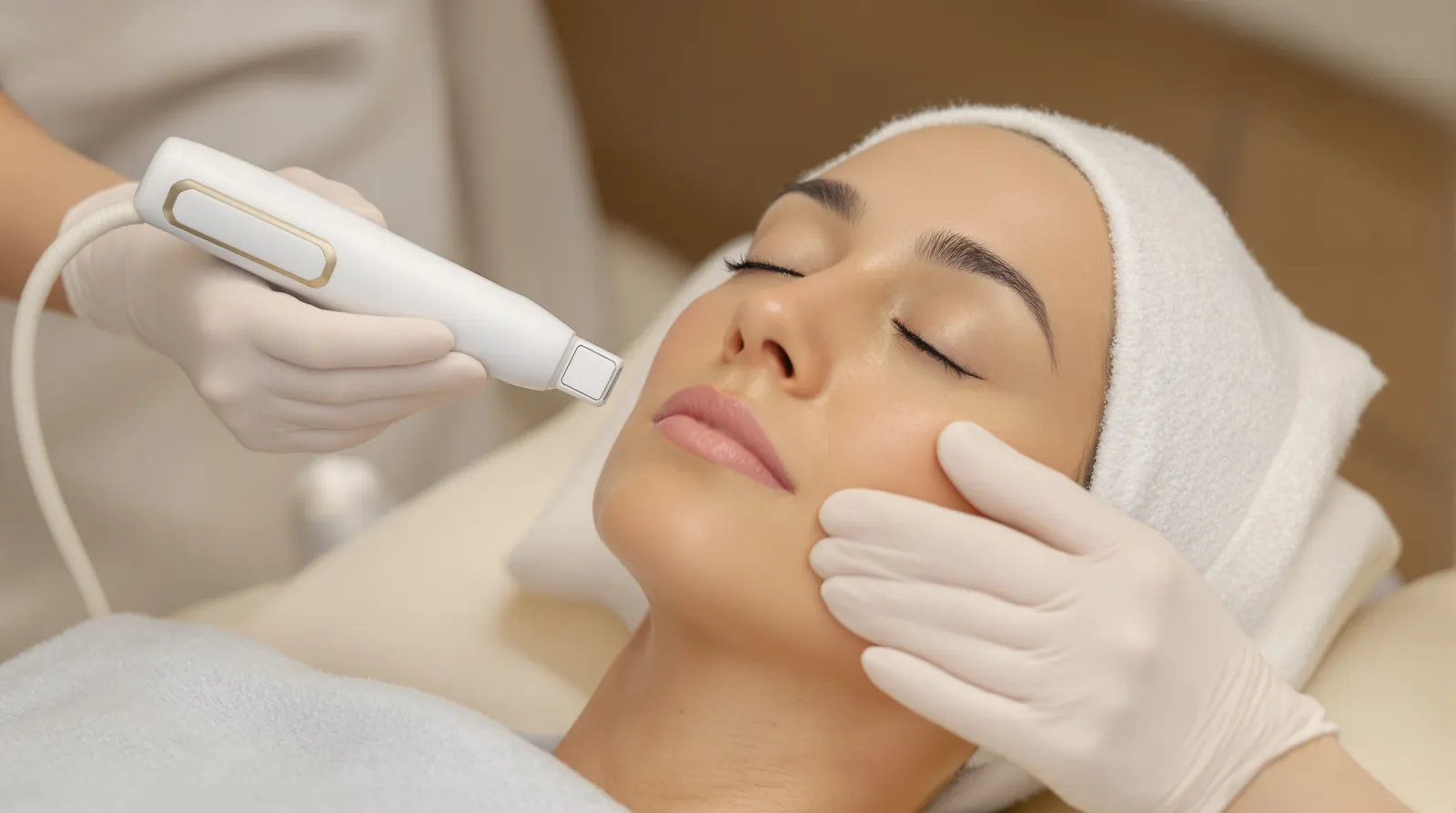
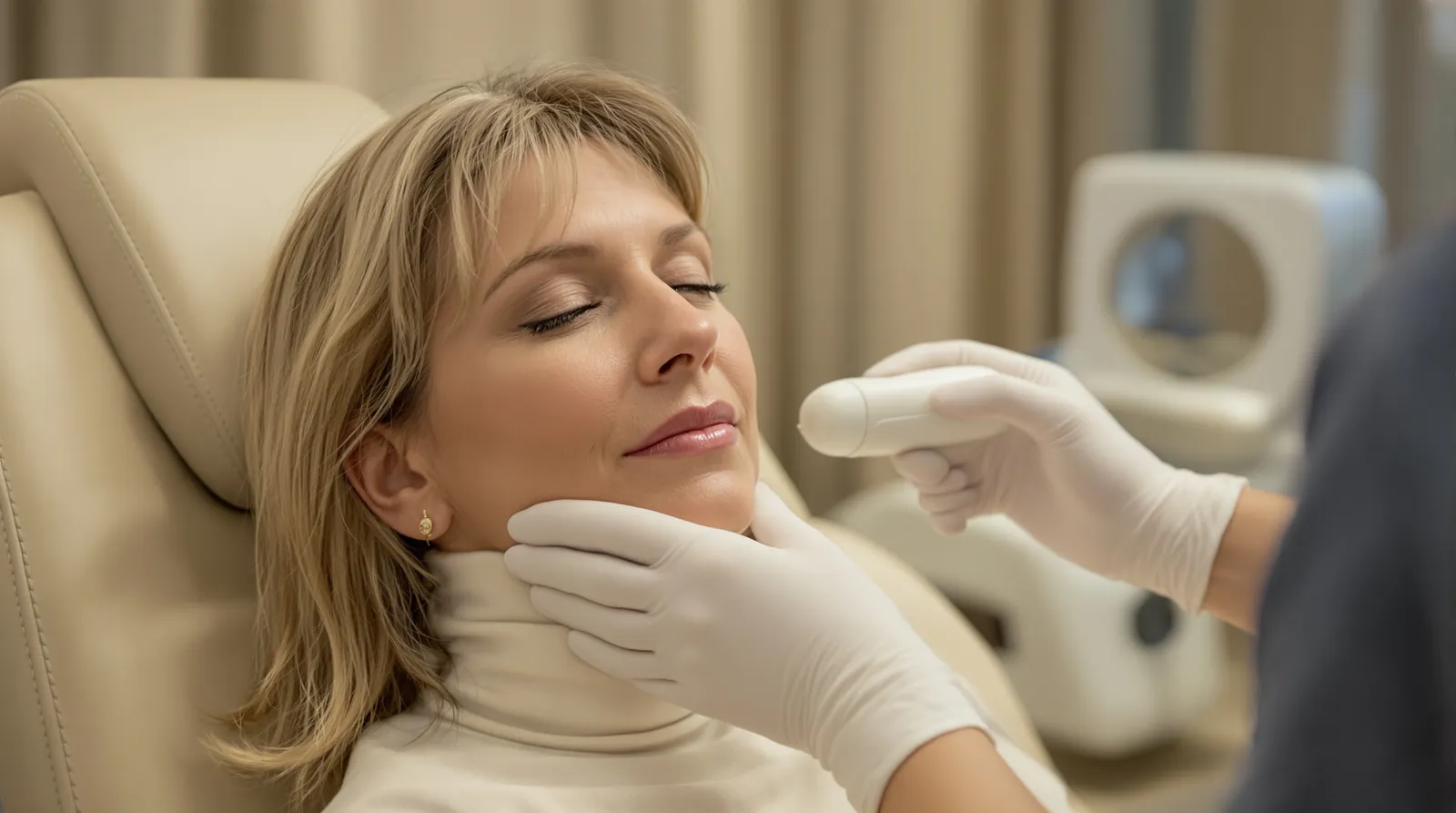
Ultherapy® is a prescription device from Merz Aesthetics. It focuses ultrasound energy at set depths below the surface of the skin, creating tiny points of heat without cutting or opening the skin. Your body responds by building new collagen, which can gradually lift and firm loose skin.
Built-in ultrasound imaging lets the provider see the layers beneath your skin on a screen, to confirm good contact and the right treatment depth.
Where each lifting treatment works
- Focused ultrasound points
- RF microneedle heat
- Surface RF warming
- Microfocused ultrasound (Ultherapy®): transducers focused at 1.5 mm, 3.0 mm and 4.5 mm
- RF microneedling (Infini): heat released through fine needles, at a depth set by the clinician
- Non-invasive radiofrequency (Oligio®): warming of the skin through the surface, without needles
What Ultherapy treats
- Lifting the eyebrow
- Lifting loose skin under the chin and on the neck
- Improving lines and wrinkles on the chest (décolleté)
- Improving the look of loose skin on the abdomen, the front and back of the arms, and the knees (clearances added in 2025 and 2026)
The body-area clearances are newer, so please ask which areas our system is set up to treat. Other uses, such as lifting the cheeks and jowls, are off-label. Ultherapy does not remove fat, including fat under the chin.
Who may be a good fit
Age alone doesn’t decide it. According to the American Academy of Dermatology, skin tightening is more likely to help when there is only a small amount of loose skin. If you have a lot of sagging, a non-surgical treatment may not help much, and a surgical opinion may serve you better.
We’ll examine your skin and give you an honest opinion.
What to expect
Consultation
We review your health history, medicines and goals, examine the area and explain whether Ultherapy is a reasonable choice.
Imaging and planning
The skin is cleansed and marked. The provider uses the device’s ultrasound screen to view the layers beneath.
Treatment
Energy is delivered in rows across the area. Many people feel moderate discomfort, so ask about comfort options beforehand.
Right after
Most people return to normal activities right away. Mild redness or swelling, if it occurs, is usually short-lived.
Results
Collagen builds slowly, so changes appear over 2 to 6 months. Some people benefit from an additional treatment later.
Comfort, results and how long they last
In a 2025 review of published studies, people rated treatment discomfort at about 5 out of 10 on average, which the authors called moderate.
Results are modest. In the first published study of Ultherapy for the brow, raters judged that 86% of people had a meaningful brow lift at 90 days; the average brow rose about 1.7 mm, less than a tenth of an inch.
The maker, Merz Aesthetics, says results can last a year or more on the face and up to 6 months on the abdomen and arms. The effect fades over time as skin continues to age. Results vary from person to person.
Side effects & risks
- Common: redness, swelling, tenderness and discomfort.
- Possible: bruising, and short-term nerve effects such as numbness, tingling or temporary muscle weakness.
- Rare: blisters, burns and nerve damage, which the FDA lists among the risks of ultrasound devices.
Call us if you notice blistering, pain that gets worse, or numbness or weakness that does not improve.
Who should not have it / talk to Dr. Shin first
Ultherapy is not used if you have:
- an open wound, broken skin or an active skin infection in the area
- an active implant, such as a pacemaker or implanted defibrillator
- metal under the skin near the area from an implant or injury
Talk to Dr. Shin first if you:
- are pregnant
- tend to form keloids (thick, raised scars)
- have had fillers, threads or other treatments in the area recently
Common questions
What is the downside of Ultherapy?
The main downsides are discomfort during treatment, results that are gradual and modest, and an effect that fades over time. Side effects can include redness, swelling, tenderness, bruising and short-term numbness or tingling, and blisters, burns and nerve damage are rare risks. It is also less likely to help if you have a lot of sagging skin.
Is 50 too old for Ultherapy?
Not by itself. The amount of loose skin matters more than age. The American Academy of Dermatology notes that skin tightening is more likely to help people with a small amount of sagging, while more sagging may call for surgery. At your consultation, we’ll examine your skin and give you an honest opinion.
How many years does Ultherapy last?
There is no set number of years. The maker, Merz Aesthetics, says results can last a year or more on the face and up to 6 months on the abdomen and arms. Skin keeps aging, so the effect gradually fades. Results vary from person to person.
Can Ultherapy tighten the neck?
Ultherapy is FDA-cleared to lift loose skin under the chin and on the neck. Changes appear gradually, typically within 2 to 6 months, and they are modest. It is more likely to help mild looseness than heavy sagging, and it does not remove fat under the chin.
Is microneedling better than Ultherapy?
Neither is better for everyone, because they work differently. Ultherapy focuses ultrasound beneath the skin without needles. RF microneedling uses very fine needles and heat within the skin, and our Infini device is FDA-cleared for facial wrinkles. We’ll suggest an option based on your skin, goals and health history. Learn more about RF microneedling.
Who is not a good candidate for Ultherapy?
Ultherapy isn’t used over open wounds or infected skin, or in people with a pacemaker or other active implant, or metal near the area. Talk with us first if you’re pregnant, form keloids or recently had fillers or threads there. People with a lot of sagging may be better served by a surgical consultation.
Important information
- Ultherapy® is FDA-cleared, not FDA-approved. It is cleared to lift the eyebrow, lift loose skin under the chin and on the neck, and improve lines on the chest (décolleté); newer clearances add loose skin on the abdomen, arms and knees. It is not cleared to remove fat, and it is not a substitute for a facelift.
Sources & further reading
- Ulthera System 510(k) summary and indications for use, K260618 (2026) (opens in a new tab) — U.S. Food & Drug Administration
- Many ways to firm sagging skin (opens in a new tab) — American Academy of Dermatology
- Non-Invasive Body Contouring Technologies (opens in a new tab) — U.S. Food & Drug Administration
- Microfocused Ultrasound With Visualization (MFU-V) Effectiveness and Safety: A Systematic Review and Meta-Analysis (Aesthetic Surgery Journal, 2025) (opens in a new tab) — PubMed, U.S. National Library of Medicine
- Ultrasound tightening of facial and neck skin: a rater-blinded prospective cohort study (Journal of the American Academy of Dermatology, 2010) (opens in a new tab) — PubMed, U.S. National Library of Medicine
- Ultherapy PRIME: Important Safety Information (opens in a new tab) — Merz Aesthetics (manufacturer)
- A prospective multicenter pilot study of microfocused ultrasound with visualization for lines and wrinkles of the décolleté (Fabi et al., 2015) (opens in a new tab) — Dermatologic Surgery
- Microfocused Ultrasound With Visualization Induces Remodeling of Collagen and Elastin Within the Skin (Marquardt et al., 2024) (opens in a new tab) — Journal of Cosmetic Dermatology
Last updated October 2026. This page is educational and does not replace a visit with a clinician.