- Helps with
- Fine lines, rough texture, sun damage and some acne or surgical scars
- Session
- Numbing and eye protection; antiviral medicine may be started if you get cold sores
- Typical course
- Scar studies often used about 3 sessions, 4 weeks apart
- Downtime
- About 1 week for fractional or erbium treatment, up to 2 weeks for full CO2
How laser resurfacing works
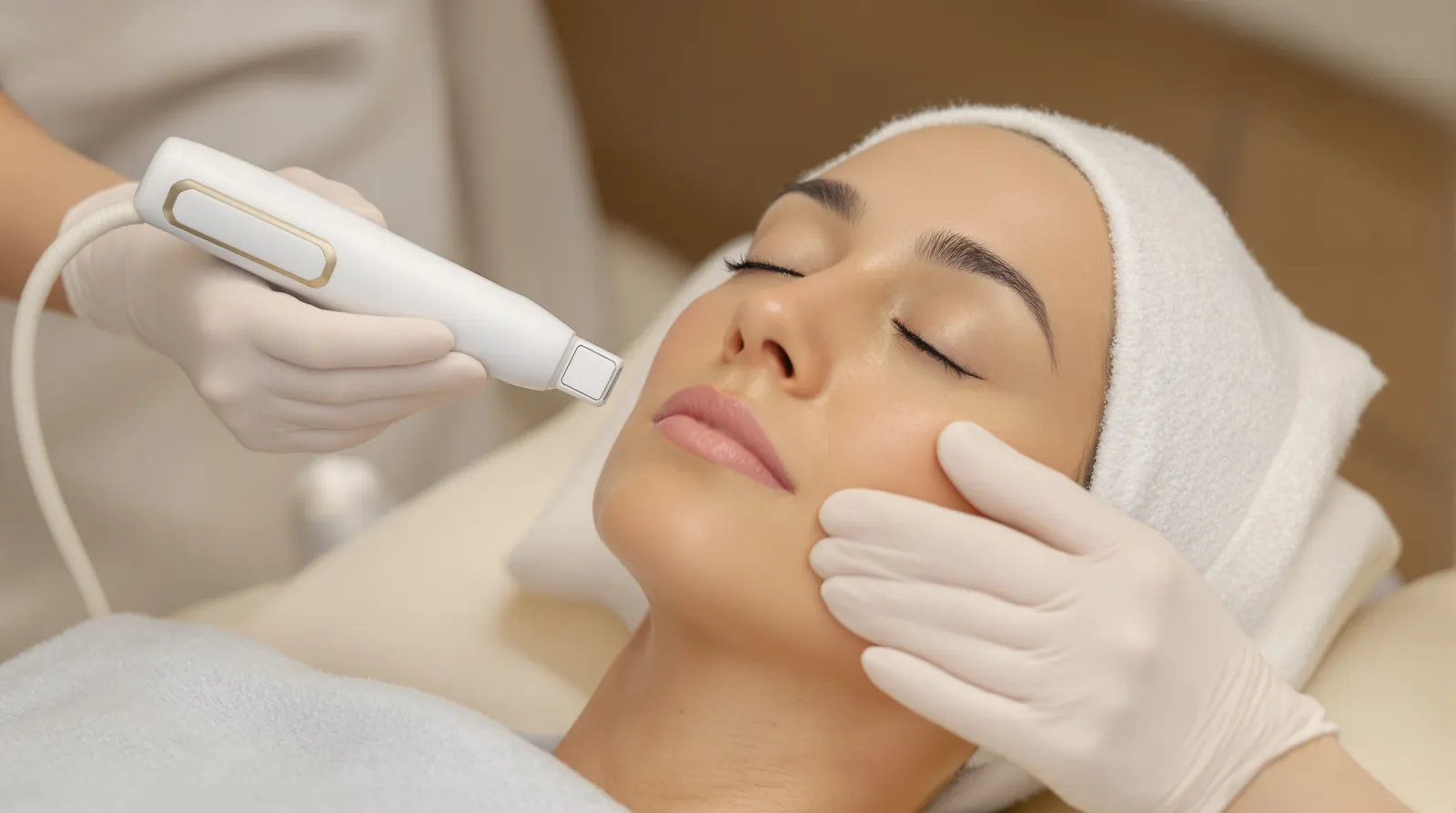
Resurfacing lasers are “ablative,” which means they remove very thin layers of skin on purpose. New skin forms as the area heals. In fractional mode, the laser treats a grid of tiny columns and leaves the skin between them untouched, which helps healing.
Cleveland Clinic notes that skin may keep improving for up to a year and the improvement may last several years, though normal aging continues.
Our resurfacing lasers
- CO2 laser (Lutronic eCO2), 10,600 nm. With fractional handpieces, it is FDA-cleared for skin resurfacing and for wrinkles, fine lines, rough texture, pigmented spots and blotchy redness. With non-fractional handpieces, certain models are also cleared to treat acne and surgical scars and to remove growths such as skin tags, warts and seborrheic keratoses.
- Pixel (Alma Harmony), a 2940-nm erbium laser with fractional tips. It is FDA-cleared for skin resurfacing.
CO2 lasers are not new: FDA clearances for CO2 surgical lasers date back to at least 1982.
Acne scars: what the research shows
A 2025 systematic review of comparison trials found that ablative lasers such as CO2 and erbium improved sunken (atrophic) scars more than non-ablative lasers, but with more pain and downtime. Treatment usually meant about three sessions, four weeks apart. In a small pilot study of a fractional erbium laser for acne scars, people had 2 to 5 sessions, 4 to 6 weeks apart, with 2 to 3 days of downtime. Scars usually improve rather than disappear.
Other scar options include RF microneedling and Bellafill®. See acne and acne scars to compare them.
Spots and growths are examined first
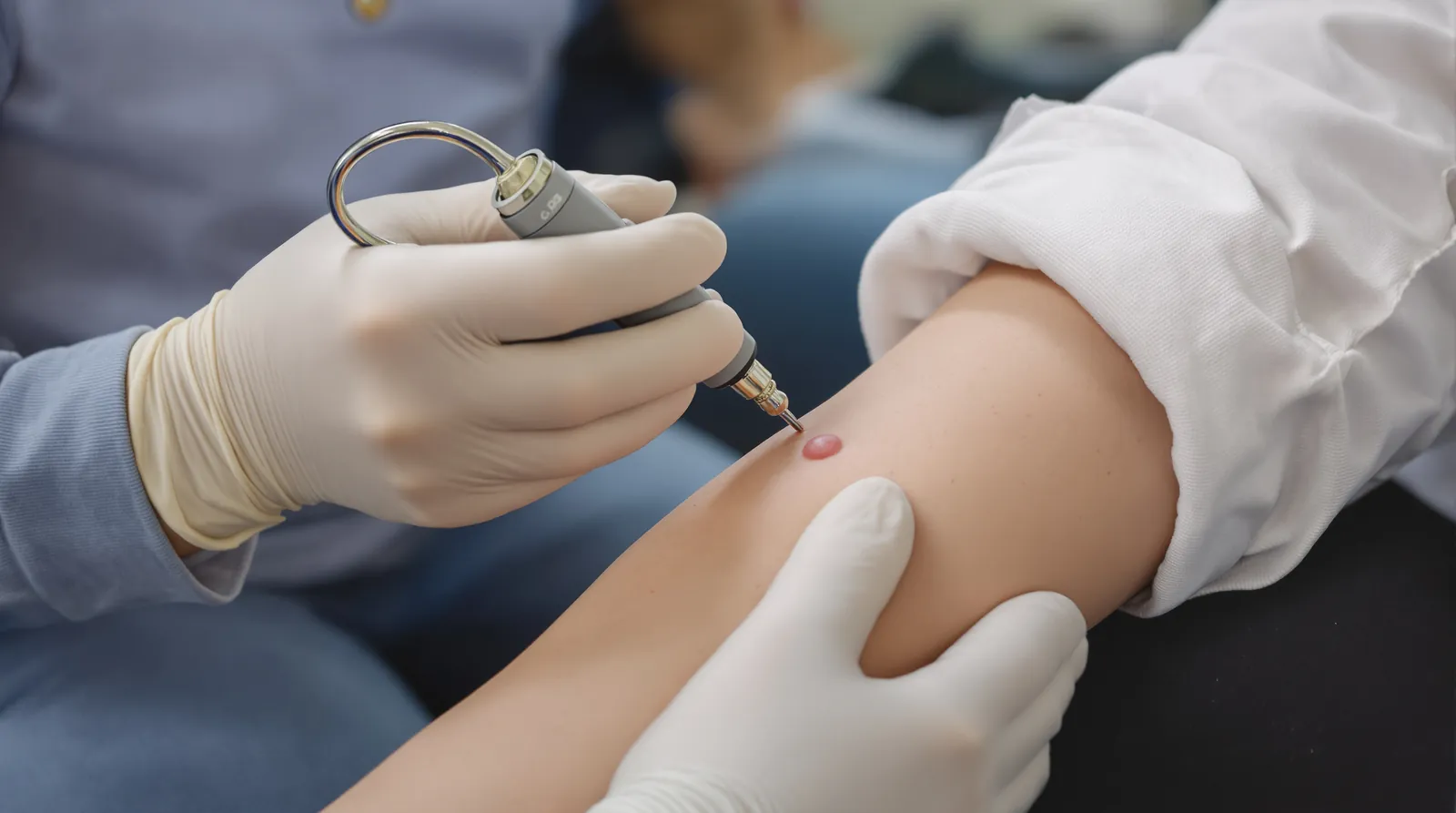
Before resurfacing or removing any growth, Dr. Shin examines your skin. A brown spot or growth that could be skin cancer is biopsied first rather than lasered. Learn about mole, wart and skin tag removal.
What to expect at our Torrance office
Consultation
Your skin type, scars, medicines and health history are reviewed, including cold sores, isotretinoin, smoking and recent tanning.
Preparing
Avoid tanning and use broad-spectrum sunscreen daily for four weeks beforehand. If you get cold sores, you may start an antiviral medicine before treatment.
Treatment day
Numbing is used, and your eyes are protected with shields or goggles while the laser treats the area.
Healing
Cleanse the area as directed and keep it moist with petroleum jelly or another ointment. Expect redness, swelling and peeling for about 1 to 2 weeks.
Side effects & risks
- Redness, swelling and peeling while the skin heals.
- Small white bumps (milia).
- Darker or lighter patches of skin, which are more likely in darker skin.
- Cold sore flare-ups and bacterial infection.
- Scarring, which is rare.
A review of fractional laser complications found they range from mild to serious, can be long-lasting, and are more likely in sensitive areas and in darker skin.
Who should not have it, or should talk to Dr. Shin first
- You take isotretinoin. A 2017 expert panel advised against fully ablative laser during isotretinoin treatment, but found no good evidence for routinely delaying fractional laser.
- You have active acne or very dark skin.
- You are pregnant. A review advises delaying elective cosmetic procedures until after the baby is born.
- You get cold sores, have a tan, or take a medicine that makes skin sensitive to the sun.
- You smoke, which slows healing.
- You have a spot that could be skin cancer.
Treatment may be performed by Dr. Shin or by a licensed registered nurse or physician assistant under his supervision.
Common questions
How long is recovery after laser resurfacing?
It depends on the laser. Cleveland Clinic says recovery takes up to two weeks after full CO2 resurfacing and about one week after fractional or erbium resurfacing. During that time, expect redness, swelling and peeling. You’ll cleanse the area as directed, keep it moist with ointment and protect it from the sun.
Will laser resurfacing get rid of my acne scars?
It can improve them, but scars usually do not disappear. A 2025 systematic review found ablative lasers such as CO2 and erbium improved sunken acne scars more than non-ablative lasers, usually over about three sessions. Results vary with the type and depth of your scars.
Can I have laser resurfacing if I have darker skin?
Sometimes, with extra caution. Darker skin has a higher risk of dark or light patches after resurfacing, and complications from fractional lasers are more likely in darker skin. A 2025 review noted that skin type guided the choice of laser because of the risk of darkening after inflammation. Dr. Shin will consider your skin type before recommending any option.
I took isotretinoin (Accutane). Do I need to wait?
Tell us about any isotretinoin use. A 2017 expert panel found that fully ablative laser resurfacing is not recommended during isotretinoin treatment, but it found no good evidence for routinely delaying fractional laser procedures. Dr. Shin will discuss the timing that makes sense for you.
What is the difference between CO2 and erbium lasers?
Both are ablative lasers that remove thin layers of skin. CO2 lasers use 10,600-nm light, and erbium lasers use 2940-nm light. Cleveland Clinic says erbium resurfacing tends to cause less swelling, bruising and redness than CO2, with about one week of recovery compared with up to two weeks for full CO2 resurfacing.
Important information
- CO2 (eCO2) and Pixel erbium lasers are FDA-cleared for skin resurfacing. Acne scar treatment is a cleared use of certain eCO2 models with non-fractional handpieces; depending on the device model and handpiece, it may be an off-label use. Dr. Shin will review the evidence, risks and alternatives with you.
Sources & further reading
- Laser skin resurfacing (opens in a new tab) — Cleveland Clinic
- 510(k) K100610: eCO2 Plus Laser System (opens in a new tab) — U.S. Food & Drug Administration
- 510(k) K091115: eCO2 Laser System (opens in a new tab) — U.S. Food & Drug Administration
- 510(k) K072564: Alma Lasers Harmony XL with Pixel (opens in a new tab) — U.S. Food & Drug Administration
- 510(k) K820101: CO2 surgical laser (1982) (opens in a new tab) — U.S. Food & Drug Administration
- Ablative and non-ablative laser therapies for atrophic, hypertrophic and keloid scars: a systematic review of comparative trials (Haji Mohammadi et al., 2025) (opens in a new tab) — Lasers in Medical Science, via PubMed
- Fractional Er:YAG laser for atrophic facial acne scars: a pilot study (Firooz et al., 2016) (opens in a new tab) — Journal of Cosmetic and Laser Therapy, via PubMed
- Fractionated laser skin resurfacing treatment complications: a review (Metelitsa & Alster, 2010) (opens in a new tab) — Dermatologic Surgery, via PubMed
- Isotretinoin and timing of procedural interventions: consensus recommendations (Spring et al., 2017) (opens in a new tab) — JAMA Dermatology, via PubMed
- Safety of cosmetic dermatologic procedures during pregnancy (Lee et al., 2013) (opens in a new tab) — Dermatologic Surgery, via PubMed
- 5 reasons to see a dermatologist for mole, skin tag removal (opens in a new tab) — American Academy of Dermatology
Last updated October 2026. This page is educational and does not replace a visit with a clinician.