- Helps with
- Visible facial blood vessels, rosacea redness and small spider veins
- Session
- Eye protection for everyone; some people feel tightness, itching or brief pain
- Typical course
- Often 1 to 3 treatments for visible vessels, spaced 3 to 4 weeks apart
- Downtime
- Redness usually fades within 2 weeks; any purple spots clear in 1 to 2 weeks
What causes facial redness and visible veins
Rosacea is a common cause of facial redness. It can bring flushing, lasting redness, acne-like bumps or visible blood vessels, and it often cycles between flare-ups and calmer periods. The National Institutes of Health notes there is no cure for rosacea, but treatment can keep it under control. Rosacea may be underdiagnosed in darker skin, where redness can be harder to see.
Small visible vessels on the face are also part of sun-damaged skin, and spider veins are common on the legs.
Treatment options
- IPL (A-Tone IPL) uses flashes of filtered light that are absorbed by the red color of blood in small vessels. It is FDA-cleared for benign vascular lesions, such as small visible blood vessels.
- Aerolase LightPod Neo is a 1064-nm laser with very short pulses. It is FDA-cleared for benign vascular lesions including rosacea, spider veins, leg veins and poikiloderma of Civatte (reddish-brown patches on the sides of the neck), on all skin types.
What results to expect
The American Academy of Dermatology (AAD) says most patients see a 50% to 75% reduction in visible blood vessels after 1 to 3 laser or light treatments, spaced 3 to 4 weeks apart. Overall redness improves less: most patients in the studies the AAD describes had about a 20% reduction in redness. Results for blood vessels tend to last 3 to 5 years, but new vessels can form, so follow-up treatment may be needed. Results vary.
Rosacea care goes beyond lasers
The AAD says a rosacea treatment plan often includes medicine, a rosacea-friendly skin care routine and tips to avoid flare-ups. Sun exposure and emotional stress are common triggers, and many people discover other personal triggers too. Dr. Shin can review prescription options with you, and our medical-grade skincare page covers gentle daily care.
Leg veins
The AAD says lasers can treat spider veins and small varicose veins, often over 3 or more treatments, while larger varicose veins need other methods. Large, bulging or painful leg veins call for a vein evaluation, and you may be referred to a vein specialist. After laser treatment of leg veins, protect the area from the sun for 3 to 4 weeks.
Spots and birthmarks are checked first
Dr. Shin examines any brown spot, mole or birthmark before light or laser treatment, and anything suspicious is biopsied first. Birthmarks in babies and children, such as port-wine stains and hemangiomas, should be evaluated by a specialist.
What to expect at our Torrance office
Consultation
We look at the pattern of redness or veins, review your skin type, medicines and triggers, and discuss medical treatment options.
Eye protection
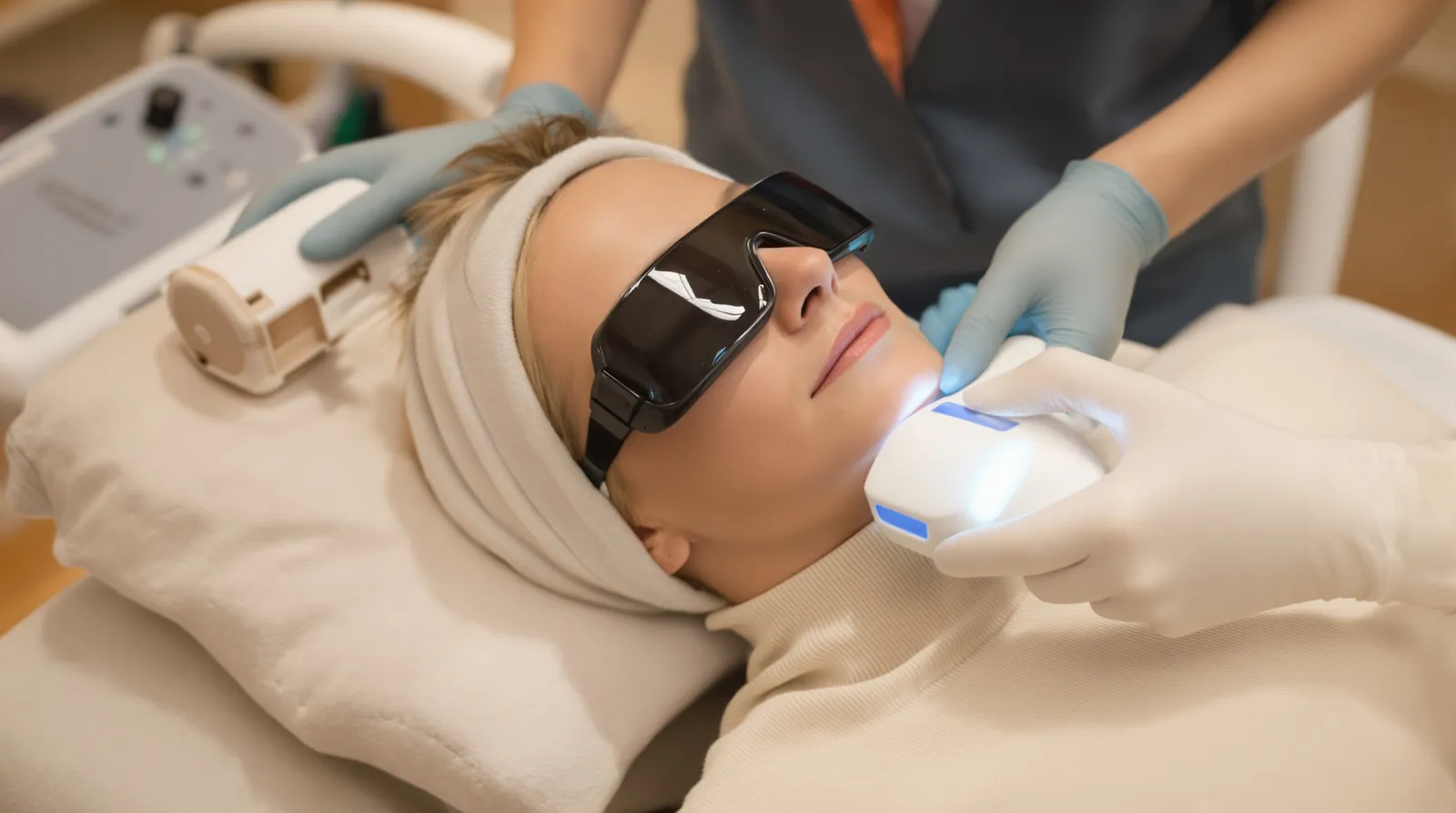
Everyone in the room wears eye protection during treatment.
Treatment
Pulses of light are delivered over the vessels. Some people feel skin tightening, itching or pain.
Aftercare
Redness usually fades within 2 weeks, and any purple or red spots tend to clear in 1 to 2 weeks. Protect the area from the sun.
Side effects & risks
- Redness, and sometimes purple or red spots, that usually clear within 2 weeks.
- Skin tightness, itching or pain during treatment.
- Changes in skin texture or color, and scarring, which are rare.
- Burns and dark marks, which are more likely on darker or tanned skin.
- Eye injury without proper eye protection.
New blood vessels can form over time, and rosacea can flare again.
Who should not have it, or should talk to Dr. Shin first
- You have a tan or a darker skin tone.
- You are pregnant. A review advises delaying elective cosmetic procedures until after the baby is born.
- You take, or recently took, isotretinoin.
- You have large, bulging or painful leg veins, which need a vein evaluation.
- Your child has a birthmark, which should be seen by a specialist.
- You have melasma and IPL is being considered, because light can darken melasma.
Treatment may be performed by Dr. Shin or by a licensed registered nurse or physician assistant under his supervision.
Common questions
Can lasers cure rosacea?
No. The National Institutes of Health notes there is no cure for rosacea, but treatment can keep it under control. Laser and light treatments can reduce visible blood vessels and some redness, and the AAD says results for vessels tend to last 3 to 5 years. New vessels can form, so treatment is usually part of a plan that includes medicine, skin care and avoiding triggers.
How many treatments will I need for facial redness?
The AAD says most patients see a 50% to 75% reduction in visible blood vessels after 1 to 3 treatments, spaced 3 to 4 weeks apart. Overall redness usually improves less, about 20% for most patients in the studies the AAD describes. Follow-up treatments may be needed as new vessels form.
Can lasers treat leg veins?
Lasers can treat spider veins and small varicose veins, often over 3 or more treatments, according to the AAD. Small spider veins may fade right away, while larger ones darken and can stay visible for 1 to 3 months. Larger varicose veins need other treatments, so bulging or painful veins call for a vein evaluation first.
Does rosacea look different on darker skin?
It can. The National Institutes of Health notes that rosacea may be underdiagnosed in people with darker skin, because darker skin can mask facial redness. The AAD describes rosacea as flushing, lasting color that may look red, violet or brown, acne-like breakouts or visible blood vessels. An exam helps sort out the cause.
Is laser treatment for redness covered by insurance?
Usually not. The AAD notes that health insurance rarely covers the cost of laser or light treatment for rosacea. We explain costs before treatment, and if you are paying yourself, you can ask for a Good Faith Estimate. For questions about coverage, please check with your health plan.
Important information
- The A-Tone IPL (K131712) and Aerolase LightPod Neo (K120235) are FDA-cleared for benign vascular lesions; the Aerolase clearance names rosacea, spider veins and leg veins. Laser and light treatments do not cure rosacea.
Sources & further reading
- Lasers and lights: How well do they treat rosacea? (opens in a new tab) — American Academy of Dermatology
- What is rosacea? (opens in a new tab) — American Academy of Dermatology
- Skin care, trigger management can help control rosacea (opens in a new tab) — American Academy of Dermatology
- Rosacea: symptoms, causes and risk factors (opens in a new tab) — National Institute of Arthritis and Musculoskeletal and Skin Diseases (NIH)
- Leg veins: Why they appear and how dermatologists treat them (opens in a new tab) — American Academy of Dermatology
- 510(k) K120235: Aerolase Nd:YAG laser (LightPod Neo) (opens in a new tab) — U.S. Food & Drug Administration
- 510(k) K131712: A-Tone IPL System (opens in a new tab) — U.S. Food & Drug Administration
- Vascular and pigmented lesions (opens in a new tab) — American Society for Laser Medicine and Surgery
- Skin conditions that lasers can treat (opens in a new tab) — American Academy of Dermatology
- Intense pulsed light on skin rejuvenation: a systematic review (Sales et al., 2021) (opens in a new tab) — Archives of Dermatological Research, via PubMed
- Clinical practice guideline for the management of infantile hemangiomas (Krowchuk et al., 2019) (opens in a new tab) — American Academy of Pediatrics, Pediatrics
- Safety of cosmetic dermatologic procedures during pregnancy (Lee et al., 2013) (opens in a new tab) — Dermatologic Surgery, via PubMed
- Ocular injury in cosmetic laser treatments of the face (Huang et al., 2018) (opens in a new tab) — Journal of Clinical and Aesthetic Dermatology, via PubMed
Last updated October 2026. This page is educational and does not replace a visit with a clinician.