- Helps with
- Skin tags, warts, seborrheic keratoses and moles that need removal or testing
- First step
- An exam; any growth that could be skin cancer is biopsied
- Session
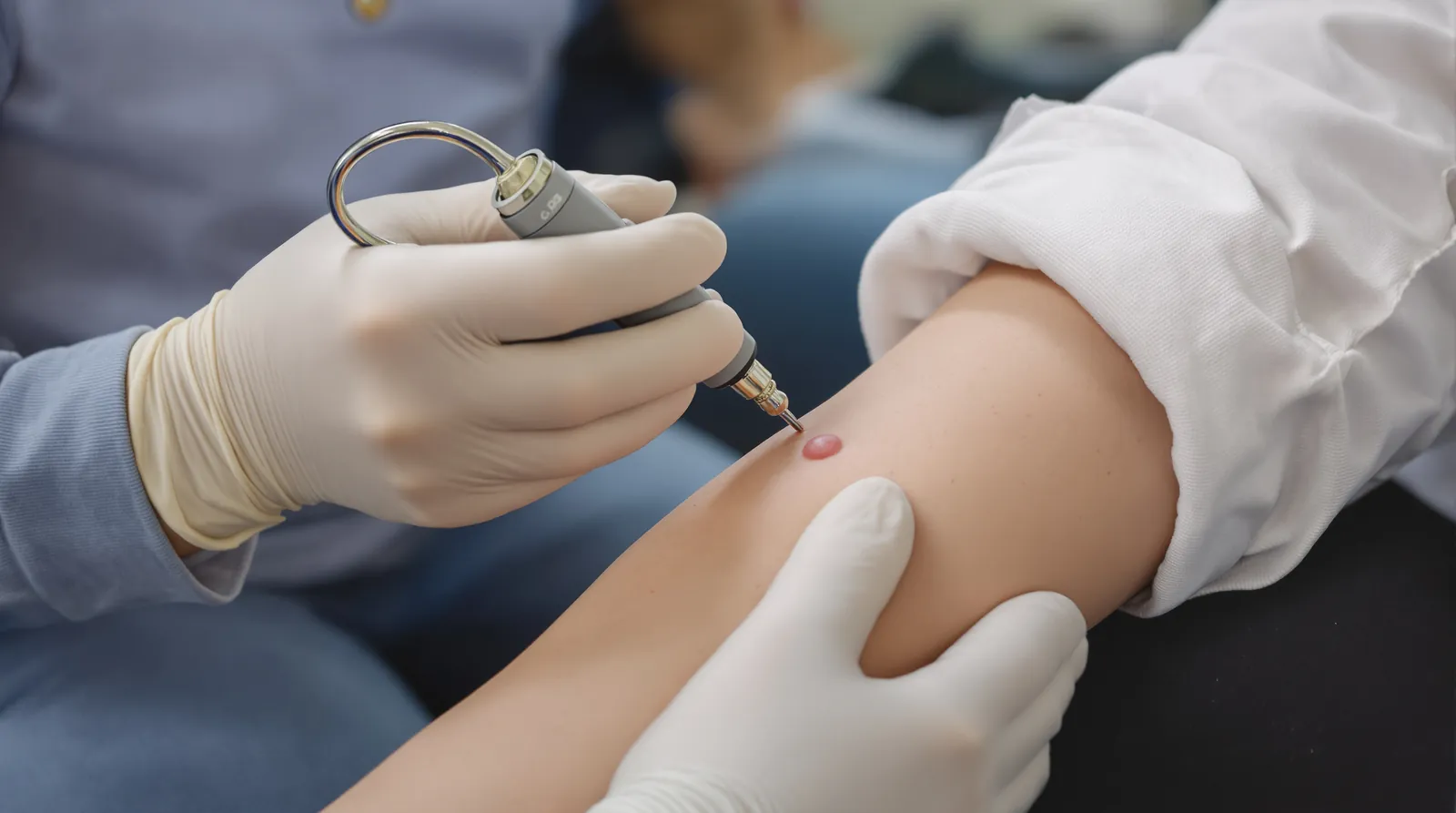
- The area is numbed first for snipping, shaving or electrosurgery
- Typical course
- Often one visit; warts may need repeat freezing every 2 to 4 weeks
- Downtime
- A small wound or scab; skin tag scabs heal in 1 to 3 weeks
Every growth is diagnosed first
Before removing any growth, Dr. Shin examines it. A mole or spot that could be skin cancer is removed and sent to a lab, where a specially trained doctor checks it under a microscope. That is the only way to know for sure. In one published case series, most melanomas later found in laser-treated areas had never been biopsied first, which is why moles are not lasered or frozen without a diagnosis.
Some spots that look like age spots are actinic keratoses, which are precancers and need medical treatment rather than cosmetic removal. For biopsies, see minor procedures and biopsies.
Removal options by type of growth
Moles
A mole is cut out (excision), sometimes with stitches, or shaved off with a surgical blade. The tissue is sent to a lab to check for cancer.
Warts
Many warts go away on their own, though it can take months to years. In-office options include freezing, repeated every 2 to 4 weeks if needed; electrosurgery with scraping, which usually takes one treatment; laser for stubborn warts; or cutting the wart out.
Skin tags
Skin tags can be frozen, snipped off after numbing, or destroyed with a tiny electric needle (electrodesiccation). Certain CO2 lasers are also FDA-cleared to remove them.
Seborrheic keratoses
These common, harmless growths usually don’t need treatment. A bothersome one can be frozen, removed with electrosurgery and scraping, or shaved off. Most don’t return, but new ones can appear elsewhere.
Moles present from birth (congenital moles)
A congenital mole is one a person is born with. It is often dark and may be hairy. MedlinePlus explains that skin cancer can develop in some people with large or giant congenital moles, and the risk is higher for larger ones. Lasers may not remove the whole mole, which can make skin cancer harder to spot, and a systematic review found only very low-quality evidence for lasers, with high rates of scarring and color returning. Congenital moles are evaluated carefully, and children and adults may be referred to a dermatologist when specialist care is needed.
What to expect at our Torrance office
Exam
Dr. Shin examines the growth, asks how long you’ve had it and whether it has changed, and explains your options.
Numbing
For snipping, shaving, cutting or electrosurgery, the area is numbed with an anesthetic first.
Removal
The growth is removed. Tissue that could be cancer is sent to a lab, and the results are reviewed with you.
Aftercare
Keep the area clean and follow your wound-care instructions. A scab may form and heal over 1 to 3 weeks.
Side effects & risks
- Scarring. Any wound can scar, and cutting out a growth may leave a scar.
- Lighter or darker skin. Freezing can lighten, darken or scar the skin. After seborrheic keratosis removal, the skin may be lighter; this usually fades with time but sometimes does not.
- Soreness, swelling, bleeding or a blister after freezing or electrosurgery.
- Infection, which careful technique and good aftercare help prevent.
Please don’t remove a mole or skin tag at home. The AAD warns this can leave skin cancer cells behind, cause infection and scarring, and delay a skin cancer diagnosis.
Who should talk to Dr. Shin first
- You have a new, changing or bleeding growth. It needs a diagnosis, not cosmetic removal.
- You are pregnant. A review of cosmetic procedures in pregnancy found that minor procedures such as shaving, snipping and electrocautery can generally be done, but tell us first.
- Your child has a large mole present from birth.
- You scar easily or have had a keloid.
- You have many warts, warts on your face or genitals, diabetes or a weakened immune system.
Procedures may be performed by Dr. Shin or, where California rules allow, by a licensed physician assistant or registered nurse under his supervision.
Insurance and cost
If a growth needs removal for a medical reason, such as testing a spot that could be skin cancer, your health plan may cover it, depending on your plan. The AAD notes that insurance rarely covers the cost of removal done only for appearance. We explain costs before your procedure, and self-pay patients can ask for a Good Faith Estimate.
Common questions
Can I remove a mole or skin tag at home?
Please don’t. According to the AAD, no product sold for removing moles, skin tags or other growths at home has FDA approval, and the FDA warns people not to use them. Home removal can cause scarring and infection. If the spot is a skin cancer, it can leave cancer cells behind and delay the diagnosis.
Can you laser off a mole?
Moles are not lasered without a diagnosis. Cutting out or shaving a mole lets a lab check the tissue for cancer. A published case series found that laser treatment of pigmented spots can complicate and delay a melanoma diagnosis. Warts, skin tags and seborrheic keratoses are different, and some can be removed with a laser cleared for that use.
Will removal leave a scar?
It can. Any wound to the skin can scar, and cutting out a growth may leave a scar. Freezing can lighten or darken the skin, and after seborrheic keratosis removal the skin may look lighter; this usually fades with time but sometimes does not. Tell us if you tend to form thick scars.
Do warts go away on their own?
Many do. The AAD says most warts are harmless and many clear without treatment, but it can take months to years. See a doctor if a wart is on your face or genitals, changes or hurts, or hasn’t improved with home treatment, or if you have diabetes or a weakened immune system.
Is mole removal covered by insurance?
It depends on why the mole is removed and on your plan. Removing a spot to test it for skin cancer is a medical reason, and your plan may cover it. The AAD notes that insurance rarely covers the cost of removal done only for appearance. Please check with your health plan and ask us about costs.
Important information
- No product sold for removing moles, skin tags or other growths at home has FDA approval. Certain CO2 lasers are FDA-cleared to remove skin tags, warts and seborrheic keratoses.
Sources & further reading
- Moles: Diagnosis and treatment (opens in a new tab) — American Academy of Dermatology
- Warts: Diagnosis and treatment (opens in a new tab) — American Academy of Dermatology
- Skin tags: Why they develop, and how to remove them (opens in a new tab) — American Academy of Dermatology
- Seborrheic keratoses: Diagnosis and treatment (opens in a new tab) — American Academy of Dermatology
- 5 reasons to see a dermatologist for mole, skin tag removal (opens in a new tab) — American Academy of Dermatology
- Actinic keratosis: Overview (opens in a new tab) — American Academy of Dermatology
- Giant congenital nevus (opens in a new tab) — MedlinePlus, U.S. National Library of Medicine
- Laser treatment of congenital melanocytic naevi: a systematic review (Eggen et al., 2018) (opens in a new tab) — British Journal of Dermatology, via PubMed
- Melanoma diagnosed in lesions previously treated by laser therapy (Delker et al., 2016) (opens in a new tab) — Journal of Dermatology, via PubMed
- 510(k) K100610: eCO2 Plus Laser System (opens in a new tab) — U.S. Food & Drug Administration
- A review of the safety of cosmetic procedures during pregnancy and lactation (Trivedi et al., 2017) (opens in a new tab) — International Journal of Women’s Dermatology, via PubMed
Last updated October 2026. This page is educational and does not replace a visit with a clinician.