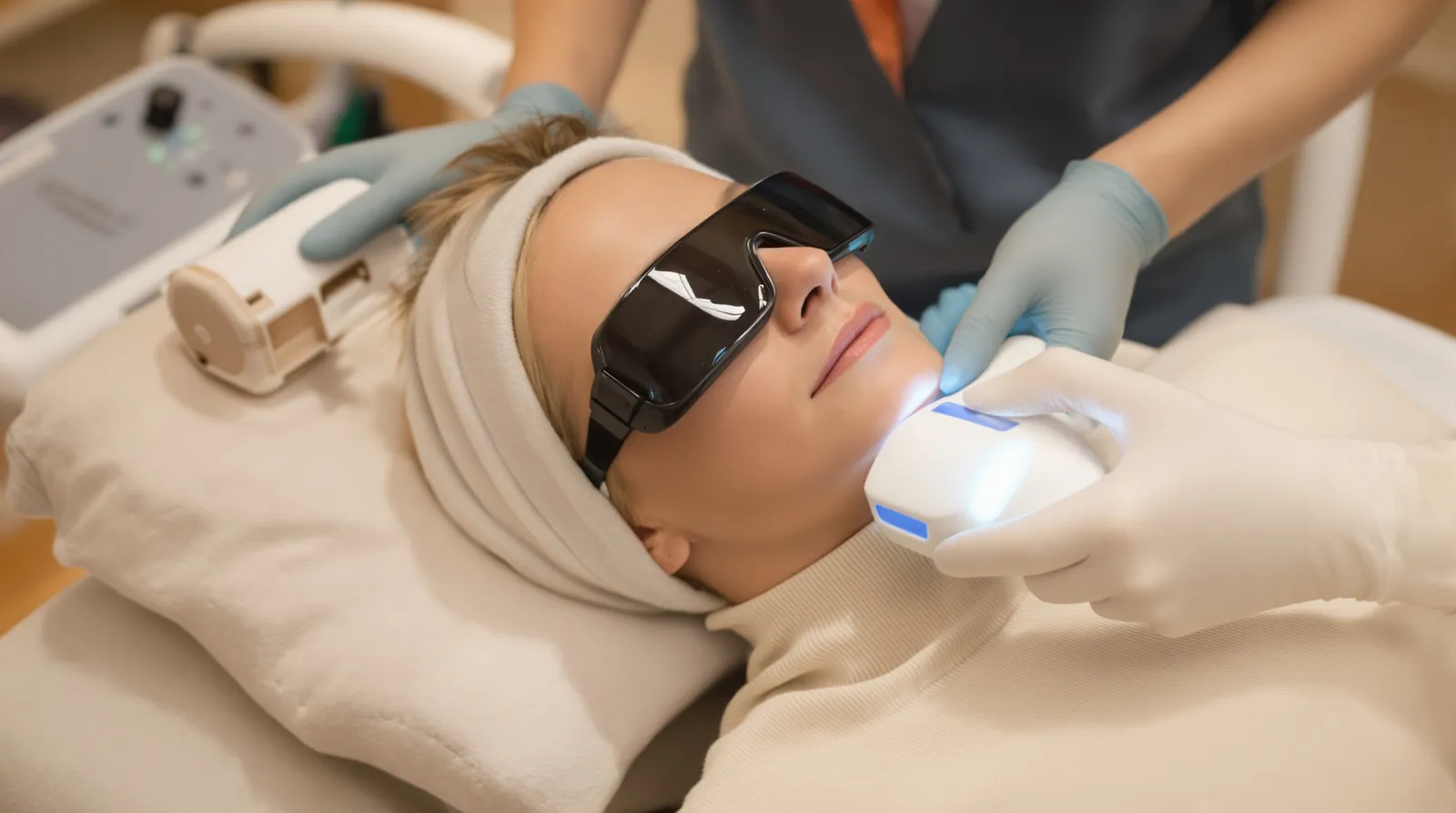
- Session
- Eye protection for everyone; time depends on the size of the area
- Typical course
- Most people need 2 to 6 treatments, about 4 to 6 weeks apart
- Downtime
- Most people return to usual activities right away; redness may last 1 to 3 days
How laser hair removal works
Laser light or pulsed light passes into the skin and is absorbed by the pigment (melanin) in hair follicles. The heat damages the follicles, so fewer hairs grow back.
Because the light targets pigment, contrast matters. The American Academy of Dermatology (AAD) says laser hair removal can be done on all skin tones when there is contrast between skin and hair color, and that it won’t work on blond, white, gray or red hair.
Matching the device to your skin and hair
Different devices use different kinds of light, and the choice depends on your skin tone, hair color and health history. Options may include:
- Candela GentleLase, a long-pulse alexandrite laser (755 nm) that uses a quick, cold spray to protect the skin’s surface. It is FDA-cleared for permanent hair reduction on all skin types (I to VI), including tanned skin.
- Aerolase LightPod Neo, a 1064-nm Nd:YAG laser with very short pulses. It is FDA-cleared for hair reduction and for razor bumps (pseudofolliculitis barbae) on all skin types.
- A-Tone IPL, which uses flashes of filtered light and is not a laser. It is FDA-cleared for permanent hair reduction.
Even when a clearance covers all skin types, darker skin is more prone to burns and dark marks, according to the AAD. A research review found the longer-wavelength 1064-nm Nd:YAG laser is generally preferred for darker skin.
Different lights, different targets
- Pigment & vessels
- Hair & deeper pigment
- Water — resurfacing
- 532 nm (KTP / Nd:YAG) — hemoglobin in small vessels and surface pigment
- 530–1100 nm (IPL, filtered broadband light) — sun spots and redness
- 755 nm (alexandrite) — melanin in hair follicles
- 1064 nm (Nd:YAG, including picosecond) — deeper pigment, dark tattoo ink, hair in darker skin
- 2940 nm (erbium) and 10,600 nm (CO₂) — water in skin, for resurfacing
How many treatments you may need
The AAD says most people need 2 to 6 treatments, usually 4 to 6 weeks apart, and can expect about a 10% to 25% reduction in hair after the first treatment. Some people need more, and maintenance sessions may be needed to keep an area clear. Hair color, skin tone, the body area and hormones all play a part. Results vary from person to person.
What to expect at our Torrance office
Consultation and exam
We review your health history, medicines, skin tone and hair color. Tell us about a recent tan, cold sores, keloids, pregnancy or isotretinoin use.
Before your visit
Avoid tanning outdoors and in tanning beds, skip sunless tanners, and use a broad-spectrum SPF 30+ sunscreen. You’ll receive instructions on preparing the area.
During treatment
Everyone in the room wears eye protection. Many people say the pulses feel like warm pinpricks or a rubber band snap. A numbing gel takes about 30 to 60 minutes to work.
Aftercare and next visit
Redness and swelling usually fade in 1 to 3 days. Keep treated skin out of the sun, and plan the next session about 4 to 6 weeks later.
Side effects & risks
Redness, swelling and mild discomfort for 1 to 3 days are the most common side effects. The AAD lists rare risks that include blistering, cold sore outbreaks, infection, scarring, and lighter or darker patches of skin. Some changes in skin color do not fade.
- Burns and dark marks are more likely on darker or tanned skin.
- More hair instead of less. A review found paradoxical hair growth near treated areas in about 0.6% to 10% of patients, most often on the face and neck.
- Eye injury can happen without proper eye protection.
Who should not have it, or should talk to Dr. Shin first
- You have a tan. The AAD advises waiting until a tan has faded completely.
- You are pregnant. A review of cosmetic procedures in pregnancy advises limiting hair removal to shaving, waxing and creams.
- You take, or recently took, isotretinoin. A 2017 expert panel found no good evidence for routinely delaying laser hair removal, but tell us.
- You get cold sores or genital herpes, scar easily, or have had a keloid.
- You have a hormone condition such as polycystic ovary syndrome (PCOS), which can make results less predictable.
In California, laser hair removal must be performed by a physician, or by a registered nurse or physician assistant under a physician’s supervision. Your treatment may be performed by Dr. Shin or by a licensed registered nurse or physician assistant under his supervision.
Common questions
Does laser really remove hair permanently?
Not completely. FDA-cleared devices may claim “permanent hair reduction,” which their FDA labeling defines as a long-term, stable drop in the number of hairs that regrow, measured 6, 9 and 12 months after a treatment series. Some hair usually remains or grows back, and maintenance treatments may be needed. On a woman’s face, hair may return because of hormones.
How painful is hair laser removal?
Most people feel some discomfort. The American Academy of Dermatology says many patients describe the pulses as warm pinpricks or a rubber band snapping against the skin. A numbing gel can help and takes about 30 to 60 minutes to work. The GentleLase laser also sprays a quick burst of cold to protect the skin’s surface.
Who is not a good candidate for laser hair removal?
According to the AAD, laser hair removal won’t work on blond, white, gray or red hair. Wait if you have a tan or are pregnant. Talk with Dr. Shin first if you get cold sores, form keloids, recently took isotretinoin, or have a hormone condition such as PCOS.
Can PCOS hair be removed by laser?
Laser treatment can reduce dark, coarse hair in people with polycystic ovary syndrome (PCOS), but it does not treat the hormone imbalance behind it. New hair may keep appearing, so results are less predictable and touch-up sessions are common. Because extra hair can be a sign of a hormone problem, a women’s health visit to look at the cause is a good idea.
Why am I more hairy after laser?
Rarely, laser or light treatment makes more hair grow near the treated area. This is called paradoxical hypertrichosis. A review reported it in about 0.6% to 10% of patients, most often on the face and neck, and more often with darker skin, dark thick hair or hormone conditions. It is usually treated with more laser treatment of that area, so let us know if you notice it.
Will 6 sessions of laser hair removal be enough?
Often, but not always. The American Academy of Dermatology says most patients need 2 to 6 treatments, and some need more. Maintenance sessions may also be needed to keep an area clear, and hair on a woman’s face may return because of hormones. We’ll give you a realistic estimate after your exam.
Important information
- FDA status: The lasers and IPL described on this page are FDA-cleared for “permanent hair reduction.” In FDA labeling, this means a long-term, stable reduction in the number of hairs that regrow, measured 6, 9 and 12 months after a treatment series. It does not mean all hair is removed.
- A safety note about numbing creams. Please don’t apply strong numbing products on your own before a laser visit. The FDA warns consumers not to use over-the-counter numbing products with more than 4% lidocaine, not to apply them heavily over large areas, and not to cover them with plastic wrap. Serious side effects such as an irregular heartbeat, seizures and breathing trouble can occur. If numbing is right for you, we’ll explain what to use and how.
Sources & further reading
- Laser hair removal: FAQs (opens in a new tab) — American Academy of Dermatology
- Laser hair removal: Be prepared with these facts (opens in a new tab) — American Academy of Dermatology
- Laser hair removal: Overview (opens in a new tab) — American Academy of Dermatology
- 6 ways to remove unwanted hair (opens in a new tab) — American Academy of Dermatology
- Skin conditions that lasers can treat (opens in a new tab) — American Academy of Dermatology
- 510(k) K140732: GentleLASE Family of Laser Systems (opens in a new tab) — U.S. Food & Drug Administration
- 510(k) K120235: Aerolase Nd:YAG laser (LightPod Neo) (opens in a new tab) — U.S. Food & Drug Administration
- 510(k) K131712: A-Tone IPL System (opens in a new tab) — U.S. Food & Drug Administration
- FDA warns consumers to avoid certain topical pain relief products due to potential for dangerous health effects (opens in a new tab) — U.S. Food & Drug Administration
- Laser hair removal: a review (Gan & Graber, Dermatologic Surgery, 2013) (opens in a new tab) — PubMed
- Paradoxical hypertrichosis after laser therapy: a review (Desai et al., Dermatologic Surgery, 2010) (opens in a new tab) — PubMed
- A review of the safety of cosmetic procedures during pregnancy and lactation (Trivedi et al., 2017) (opens in a new tab) — International Journal of Women’s Dermatology, via PubMed
- Isotretinoin and timing of procedural interventions: consensus recommendations (Spring et al., 2017) (opens in a new tab) — JAMA Dermatology, via PubMed
- Ocular injury in cosmetic laser treatments of the face (Huang et al., 2018) (opens in a new tab) — Journal of Clinical and Aesthetic Dermatology, via PubMed
- Medical spas: what you need to know (opens in a new tab) — Medical Board of California
Last updated October 2026. This page is educational and does not replace a visit with a clinician.