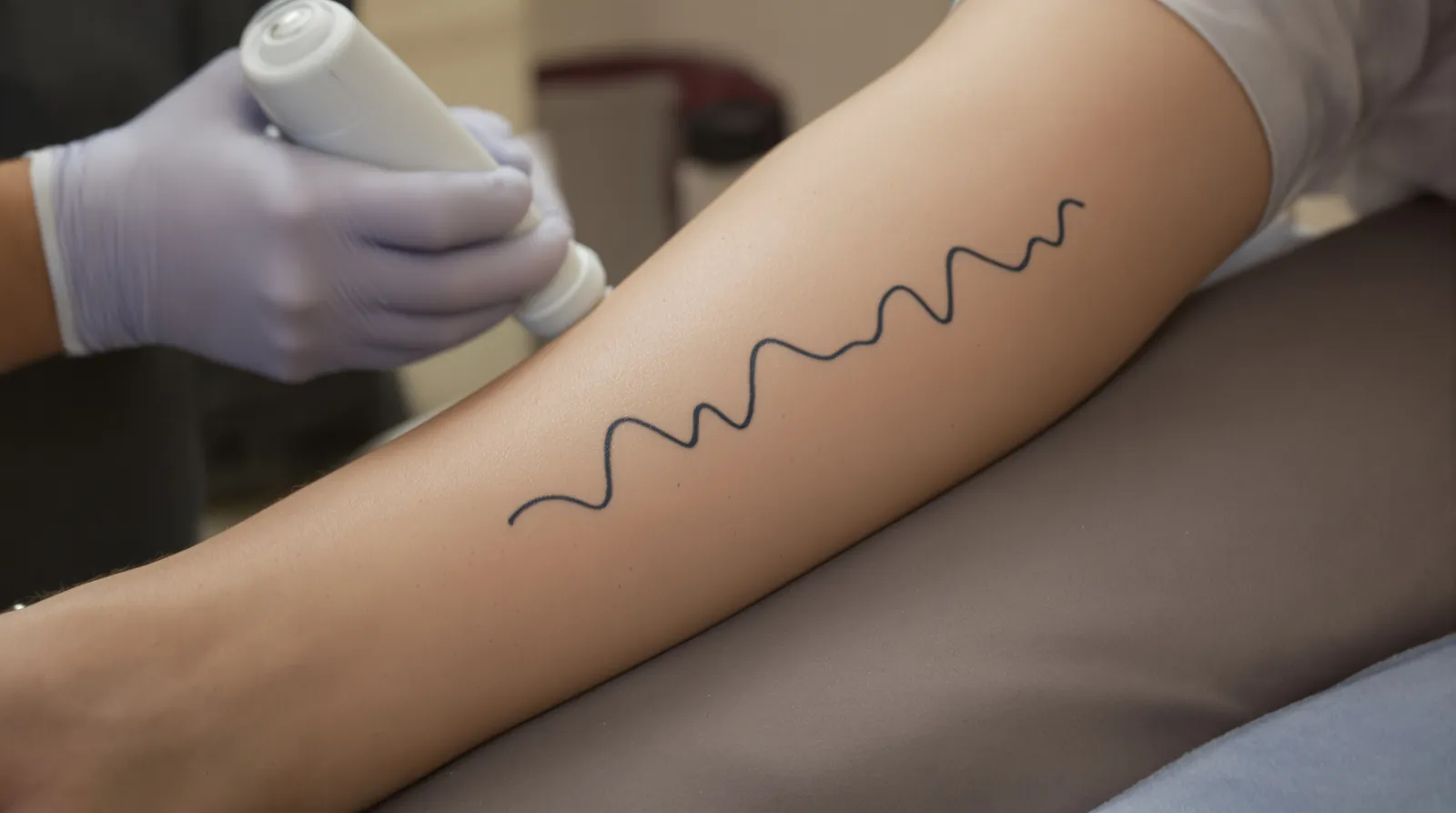
- Helps with
- Unwanted tattoos and harmless brown spots such as sun spots
- Session
- Laser eye protection for everyone; numbing may be offered for tattoos
- Typical course
- Several sessions; tattoo sessions are usually 6 to 8 weeks apart
- Downtime
- Short-lived redness and swelling; tiny pinpoint bleeding spots can occur
What is the PicoCare® Majesty laser?
PicoCare® Majesty, made by Wontech in Korea, is a picosecond Nd:YAG laser. It uses two wavelengths of light, 1064 nm and 532 nm, in pulses that last trillionths of a second. The pulses break tattoo ink or excess pigment into tiny particles that the body clears over the following weeks.
Different handpieces shape the beam. One, called a micro-lens array (MLA), splits the beam into many tiny beams.
What PicoCare® treats
Under FDA clearance K241144 (2024), PicoCare Majesty is cleared for:
- Tattoo removal at 1064 nm for black, brown, green, blue and purple inks, on all skin types (I to VI).
- Tattoo removal at 532 nm for red, yellow and orange inks, on skin types I to III.
- Benign pigmented lesions, such as sun spots, on skin types I to IV.
Skin type describes how skin reacts to the sun, from type I (always burns) to type VI (rarely burns). For tattoos, see laser tattoo removal.
Brown spots are examined first
Before any laser treatment of a brown spot, Dr. Shin examines it. A new, changing or unusual spot is biopsied first, because lasering a spot that turns out to be melanoma can delay the diagnosis. Moles should be checked and, when in doubt, biopsied rather than lasered.
What to expect at our Torrance office
Consultation
We review your skin type, your tattoo or spots, your health history and your goals, and check any suspicious spot first.
Comfort
For tattoo removal, a numbing cream or a numbing injection may be used.
Treatment
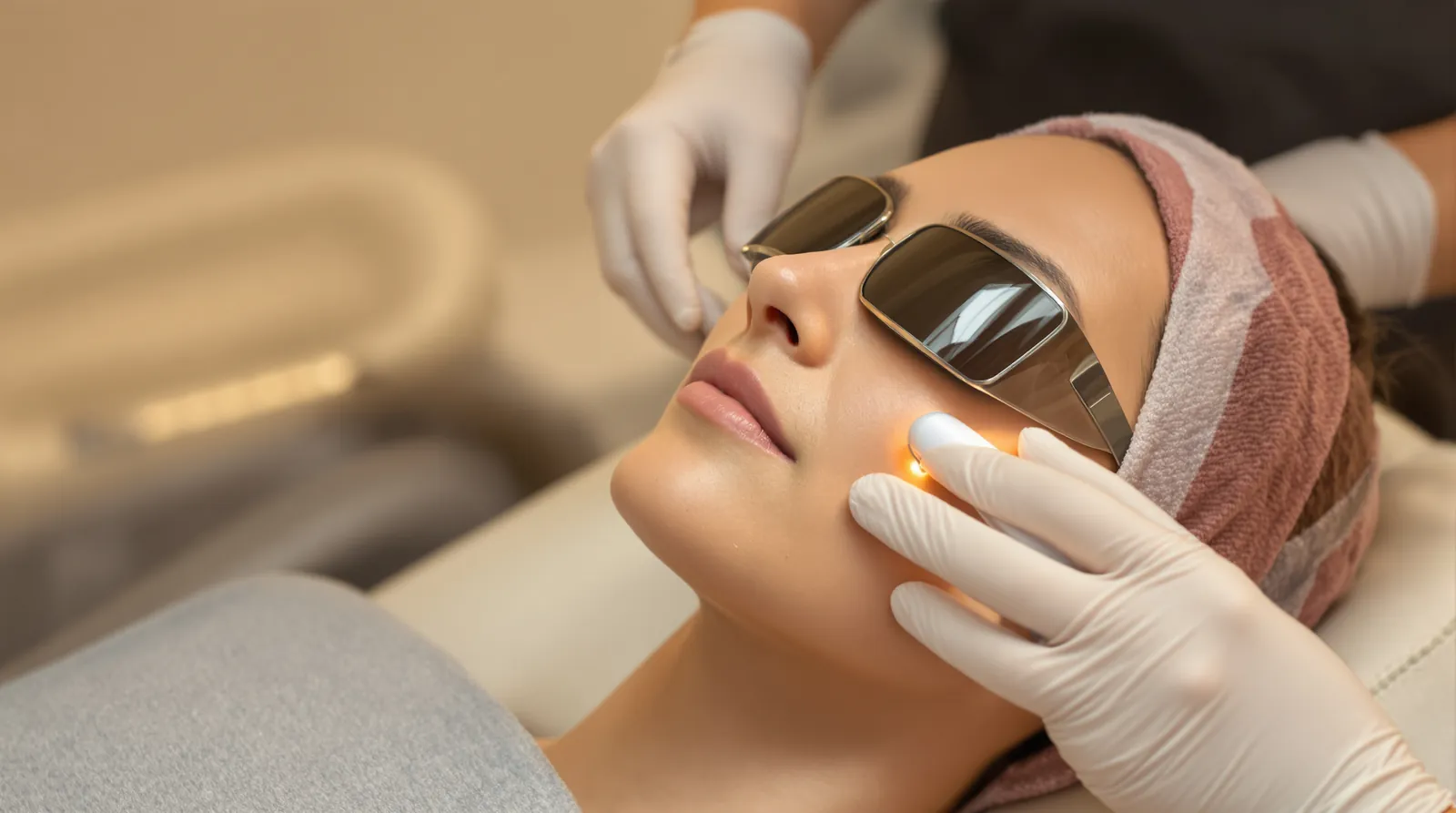
Everyone in the room wears laser eye protection while the handpiece delivers pulses over the area.
Aftercare
Keep the area clean and out of direct sun. Once it heals, use a broad-spectrum SPF 30+ sunscreen.
How many sessions you may need
Most treatments take several sessions. For tattoos, the American Society for Laser Medicine and Surgery says sessions are usually spaced 6 to 8 weeks apart, and some tattoos never fully clear. In a systematic review of picosecond tattoo studies, 69% to 100% of tattoos had more than 70% of the ink cleared after 1 to 10 treatments. The same review found only limited evidence that picosecond lasers work better than older Q-switched lasers. Results vary.
Side effects & risks
The systematic review reported pain, redness, swelling, pinpoint bleeding, blisters, and darker or lighter patches of skin. Other risks include:
- Scarring and infection.
- Rare allergic reactions as tattoo ink breaks down.
- Pinpoint bleeding after micro-lens (MLA) treatment.
- Eye injury without proper eye protection.
Who should not have it, or should talk to Dr. Shin first
- You have a darker skin tone. The 532-nm tattoo clearance covers skin types I to III, and brown-spot treatment covers types I to IV. Darker skin is also more prone to dark marks after laser treatment.
- You have a tan or recent sun exposure.
- You have a new or changing mole or spot.
- You are pregnant. Elective laser treatment is usually put off.
- You take, or recently took, isotretinoin.
- You have had an allergic reaction to a tattoo.
Treatment may be performed by Dr. Shin or by a licensed registered nurse or physician assistant under his supervision.
Common questions
Is a picosecond laser better than a Q-switched laser for tattoos?
Not clearly. A systematic review found only limited evidence that picosecond lasers remove tattoos more effectively than older Q-switched lasers, and most of that evidence involved black and blue inks. Both types break ink into tiny pieces over several sessions. The right choice depends on your ink colors, skin type and the tattoo itself.
Can the PicoCare Majesty treat melasma?
Using it for melasma or “toning” is off-label. In a network meta-analysis of melasma trials, picosecond lasers ranked below Q-switched Nd:YAG lasers. Melasma care usually starts with daily sun protection and prescription creams, and melasma often returns. Dr. Shin will review the evidence, risks and alternatives with you.
Does picosecond laser treatment work on darker skin?
It depends on the use. Tattoo removal at 1064 nm is FDA-cleared for all skin types. The 532-nm setting for red, yellow and orange inks is cleared for skin types I to III, and brown-spot treatment for types I to IV. Darker skin is more prone to dark marks after laser treatment, so settings are chosen with care.
Does picosecond laser treatment hurt?
Some discomfort is common, and a systematic review of picosecond tattoo studies listed pain among the side effects. For tattoo removal, a numbing cream or a numbing injection may be used. Please tell your provider during treatment if you are uncomfortable.
Important information
- PicoCare® Majesty is FDA-cleared (K241144) for tattoo removal and for benign pigmented lesions in skin types I to IV. Use for melasma or “toning,” acne scars, pores, wrinkles, or brown spots in skin types V and VI is off-label. Dr. Shin will review the evidence, risks and alternatives with you.
- Other uses and what the research shows: Picosecond lasers are also used for acne scars, pores, wrinkles and melasma “toning.” These are off-label uses of this FDA-cleared device.
- Acne scars: a meta-analysis of seven studies found fractional picosecond lasers improved acne scars about as much as other fractional lasers, with less darkening afterward and less pain, but more short-term pinpoint bleeding. See acne and acne scars.
- Melasma: in a network meta-analysis of melasma trials, picosecond lasers ranked below Q-switched Nd:YAG lasers, and melasma often returns. See melasma care.
Sources & further reading
- 510(k) K241144: PicoCare Majesty picosecond Nd:YAG laser (opens in a new tab) — U.S. Food & Drug Administration
- Picosecond lasers for tattoo removal: a systematic review (Reiter et al., 2016) (opens in a new tab) — Lasers in Medical Science, via PubMed
- Fractional picosecond laser for atrophic acne scars: a meta-analysis (Li et al., 2023) (opens in a new tab) — Journal of Cosmetic Dermatology, via PubMed
- Comparison of the efficacy of melasma treatments: a network meta-analysis (Liu et al., 2021) (opens in a new tab) — Frontiers in Medicine, via PubMed
- Tattoo removal (opens in a new tab) — American Society for Laser Medicine and Surgery
- Tattoo removal: options and results (opens in a new tab) — U.S. Food & Drug Administration
- Laser therapy for unwanted tattoo (opens in a new tab) — American Society for Dermatologic Surgery
- Skin conditions that lasers can treat (opens in a new tab) — American Academy of Dermatology
- The role of lasers and intense pulsed light technology in dermatology (Husain & Alster, 2016) (opens in a new tab) — Clinical, Cosmetic and Investigational Dermatology, via PubMed
- Melanoma diagnosed in lesions previously treated by laser therapy (Delker et al., 2016) (opens in a new tab) — Journal of Dermatology, via PubMed
- Ocular injury in cosmetic laser treatments of the face (Huang et al., 2018) (opens in a new tab) — Journal of Clinical and Aesthetic Dermatology, via PubMed
- Safety of cosmetic dermatologic procedures during pregnancy (Lee et al., 2013) (opens in a new tab) — Dermatologic Surgery, via PubMed
Last updated October 2026. This page is educational and does not replace a visit with a clinician.